Showing posts with label Nad-e-Ali. Show all posts
Thursday, February 25, 2010
Major Mike Taylor, D Squadron 1 RTR: Manoeuvre Support Group
We are back in from the first phase of Op Moshtarak and it is great to be back in camp with hot showers and fresh food.
The last few weeks have been a real experience working as part of the Manoeuvre Support Group; a combination of Viking Armoured Personnel Carriers and the heavy engineering vehicles of 28 Engineer Regiment whose job was to clear a major route into the strategic town of Showal, a settlement with a reputation for being a drug trading haven as well as the ‘seat’ of government for the Taliban.
During the pre operational training we really bonded together well. Our role was to provide the firpower and protect the slow moving column of vehicles. So we had to practise our drills together to allow the Engineers to do their job: using new equipment to plough through or explode IED belts, build bridges, fix roads, etc.
I’m a tankie by training. I’ve got D Squadron of the Royal Tank Regiment out here. We miss our Challenger tanks, but the guys love the Viking Armoured Personal Carriers and they actually enjoy being out on the ground.
On D Day (Sat 13 Feb), several hours after the helicopter assault went in, we trundled out from Camp Bastion with my Vanguard Force in front. They are a very strong, cohesive troop commanded by Lieutenant Anthony Kaulbeck who had to guide us safely around or through the areas laid with IEDs. He recced along less obvious routes to avoid classic ambush points, searching for signs of unusual human activity on the ground. I have to say that Ant has a particular talent for this. Of the 35 IEDs that the Viking Group has discovered, he has been responsible for at least half of them. Life saving stuff really.
Our most rewarding moment of the long route clearance came on Day 2 when we were observing arcs around the leaguer (that’s the place where our 44-vehicle convoy was located, Viking APCs around the outside to provide a ‘metal fort,’ with Engineering vehicles in the middle), when one of the guys on sentry, Sgt Andy Ford, picked up abnormal behaviour in a field 200 metres away.
It was three young men and an elder. What was odd was that the men were acting aggressively towards the elder, pointing and remonstrating, which is a disrespectful way to carry on in a culture that respects age. The elder went back to his compound and soon a people carrier appeared. There was a lot of activity; the women and children were bundled into the vehicle. Meanwhile the men in the field were pretending to work, bending down and sowing seeds but all the time looking up at the leaguer location.
We suspected that the men were insurgents, and their likely plan was to take over nearby family compound to use as firing position that night.
I immediately broke out a Viking Quick Reaction Force (QRF) and headed to the compound. We managed to get there and stop the family leaving. And although they said that there were no insurgents around their fear was palpable. They wanted to get out.
We talked calmly to them and searched the compound. In the meantime the three young men had run away. The local people relaxed slightly. We reassured them that ISAF and Afghan forces were moving into the area to stay. In the end we got a decent night’s sleep without the small arms attack which had been brewing. Prevention was better than a firefight in this situation.
The locals do seem to want us here, but understandably are worried about the transition period when the Taliban still have influence. I have never spoken to a local who, in private, has a good word to say about the Taliban and the influence they hold in society. Maybe they are saying it because they are talking to ISAF, but I sense that people are starting to realise we are not necessarily the bad guys in all this.
Over the next few days we continued to provide protection as the Royal Engineers used Trojan to plough a new main route, and Python was deployed and detonated to clear a particularly difficult point with multiple IEDs on the ground. A couple of bridges were laid to improve the route access until, finally, we drove into the town of Showal and linked up with A Company 1 Royal Welsh. They had spent the week securing the town following their helicopter insertion and were very glad to see us because the route we had just cleared was soon to be used by the logistic guys bringing in fresh food, water, equipment and vital materials to build a proper patrol base.
Tuesday, February 23, 2010
Sgt Colin Pentith RLC - Fire Support Company 1 Royal Welsh
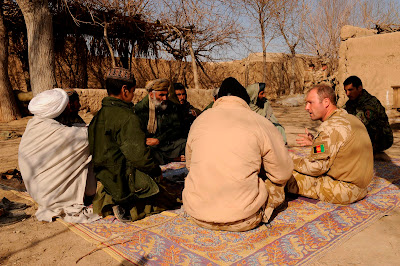
We had been on the ground for 3 days and, so far, everything was going very smoothly. The boys were into a good routine and the locals had started to actively engage with us throughout the area. The challenge for me now was to lead a Shurah at a check point established by the Afghan Army and Fire Support Company, 1 R Welsh East of Garbay Noray.
This was to be my first Shurah. A far cry from my usual job as a Royal Logistics Corps Chef! The transition from hotplate to hot stabilization really began last year when I got selected to work with 1 Royal Welsh as part of it’s non-combat role in what we call ‘influence’. Effectively it is working with other non military organizations and the locals to make progress through communication, information and initiating local projects.
The elders I met treated me with respect and what struck me from the meeting we held was that the concerns of the locals are just what you would expect anywhere. They are concerned about security first and then basic welfare – schools, hospitals, power and so on. It is up to us to reassure them that we and the Afghan National Security Services will deliver that. This was also the start of our process of getting to know who is who in the local area so that we can identify the key leaders that will make things happen.
Afterwards, as part of the stabilisation process, we distributed blankets and radios together with footballs and pens for the children. They genuinely seemed happy and there were lots of smiling faces so I think it went well. It made me feel good that, having come into their area as ‘foreign’ soldier, I could make a small but positive difference straight away.
Monday, February 22, 2010
Major Richard Gregory - Fire Support Company 1 Royal Welsh
Op Moshtarak Day 5 - Taliban Flag hauled Down
The Company and our Afghan Army partners have now firmly established a Patrol Base, east of Garbay Noray in Nadi Ali, Helmand Province.
The Patrol Base cooking area
For the first couple of days we focused on base security and defensive positions. This involved clearing all the compound areas and surrounding routes for IEDs, filling and placing sandbags for firing points and setting up a home from home in the base. A cooking area, washing area, toilet and even an improvised gym where all quickly created to make life bearable.
Toilet in Use!
By the second day we had started to build positive relationships with the elders and families in the area, holding local shuras to discuss their needs and concerns. Meanwhile our Afghan partners proudly raised the Afghanistan flag to fly above the Camp.
However out on the ground the Front Line was still clearly marked. For four days a plain white Taliban flag has flown just 300 metres away from the Patrol Base, an area where only a few of the locals are willing to go. In much of the area the threat of IEDs remained high.

As the Counter IED Team came in and cleared a route through the area the next phase of Operation Moshtarak, the ‘hold’, is beginning to take effect. The daily Shurahs held by myself are bringing the locals on side. And the regular joint patrols, led by the Afghan Army are showing that security is being brought back to the area.
Today, the fifth day of Op Moshtarak, Afghan soldiers moved in unopposed and took down the Taliban flag, removing the remaining symbol of insurgent control in the area. Another symbol of success on this operation and out on the Front Line another small victory for ISAF and the Afghan National Army.
The Company and our Afghan Army partners have now firmly established a Patrol Base, east of Garbay Noray in Nadi Ali, Helmand Province.
The Patrol Base cooking area For the first couple of days we focused on base security and defensive positions. This involved clearing all the compound areas and surrounding routes for IEDs, filling and placing sandbags for firing points and setting up a home from home in the base. A cooking area, washing area, toilet and even an improvised gym where all quickly created to make life bearable.
Toilet in Use!By the second day we had started to build positive relationships with the elders and families in the area, holding local shuras to discuss their needs and concerns. Meanwhile our Afghan partners proudly raised the Afghanistan flag to fly above the Camp.
However out on the ground the Front Line was still clearly marked. For four days a plain white Taliban flag has flown just 300 metres away from the Patrol Base, an area where only a few of the locals are willing to go. In much of the area the threat of IEDs remained high.

As the Counter IED Team came in and cleared a route through the area the next phase of Operation Moshtarak, the ‘hold’, is beginning to take effect. The daily Shurahs held by myself are bringing the locals on side. And the regular joint patrols, led by the Afghan Army are showing that security is being brought back to the area.
Today, the fifth day of Op Moshtarak, Afghan soldiers moved in unopposed and took down the Taliban flag, removing the remaining symbol of insurgent control in the area. Another symbol of success on this operation and out on the Front Line another small victory for ISAF and the Afghan National Army.
Sunday, February 21, 2010
Captain Anna Crossley QARANC. Inkerman Company, Grenadier Guards
Sharzad, Central Helmand, is a long way from the green hills of the Brecon Beacons but here I am, the first female Nursing Officer the Grenadiers have ever had! It’s taken them a bit of time to get used to the idea, but the lads will pop in to see me to discuss any problems they have or just have a chat. I hope this shows that they have accepted me as part of the team.
I'd already spent three months working in Bastion, so I've come across pretty much every type of injury you can imagine, which is extremely useful preparation for this job out at the Patrol Base where every injury, no matter how serious, will be initially dealt with by me and my team.
The soldiers here have been busy for the last few weeks. Before Op Moshtarak kicked off last weekend they were carrying out what we call ‘shaping’ operations – basically setting up and reinforcing checkpoints in the area to deny the insurgents freedom of movement. And this week they have been full tilt on Op Moshtarak going beyond the original frontline into Taliban held territory.
Back at base the majority of the work I do is primary care: treating minor ailments and making sure the troops are combat effective, that is to say, they are not prevented from doing their job by illnesses and ailments. But we are always at a high state of readiness to deal with more serious injuries.
We maintain constant contact with the Operations Room so that we are prepared to receive the patients when they arrive, but if I hear a loud bang I will always pop next door to see if we are going to be needed.
I have a team of combat medics who are on the ground and work as part of the patrolling teams. They are first on the scene and play a vital role in delivering first aid in the crucial first few minutes when something happens.
Sharzad was the original American HQ for the team that led the irrigation scheme in the 1950s. It was this scheme that created the fertile ‘Green Zone’ that runs down the Helmand River valley today. So the building we operate from is a solid 1950s brick and stone build, with all the original plans, drawings and records still here.
The facility we run is unique within the UK context. It is effectively a mini Accident and Emergency Department and we carry an extensive range of specialist kit to be able to treat people in this location. We also stabilise any more serious casualties for forward transit to Camp Bastion, and the full working hospital that is located there.
Life is busy, but the job satisfaction when we save a life out here is immeasurable.
Patrol Base Sharzad, Grenadier Guards
Saturday, February 20, 2010
Sgt Jason Thrasher 32 Regiment Royal Artillery – UAV Image Analyst
It is day 4 of Operation Moshtarak and I am watching a bank of large screens in front of me. The black and white images are crystal clear, showing me a bird’s eye view of the mighty Python moving into position on one screen, and a foot patrol of Afghan troops and Royal Welsh soldiers on patrol in a different location on another screen.
The Python is about to clear an area of suspected IEDs along the new route being created into Nad e Ali heading towards the key town of Showal. This is the first time that it is being used in Afghanistan and a small audience has gathered behind me to see what happens.
In another cabin next to the operations room the ‘pilot’ of the un-manned Hermes 450 is flying the aircraft directly over the Manoeuvre Support Group, 28 Regiment Royal Engineers. He looks like he is playing on a grown up version of a play station as he deftly guides the UAV over the tactical position on the ground.
We are in constant communication with each other because as I watch the images I can talk him through adjusting the flight path so that I can scan the whole area. My job is to make absolutely sure that there are no local Afghans, military personnel or rural compounds in the blast area. It is going to make one hell of a bang when it goes off!
Image Analysis can be a nervous business! If you make a wrong call lives could be lost. So you have to ‘Confirm in your head …confirm in your head….confirm in your head’ before you make any decision.
I confirm that the area is clear for firing.
The message is relayed to the troops on the ground, and as I watch from Camp Bastion Python lets rip! I can’t hear the sound but the black and white image in front of me explodes in an impressive cloud of dust.
Job done. Back to providing overwatch of the Combined Force 31 foot patrol as it carefully makes its way through another area of Nad e Ali. Our task to hold a secure area in Central Helmand continues with everyone working hard to keep the Taliban out and bring the civilian stabilisation teams in.
Labels:
British Forces,
Nad-e-Ali,
Op Moshtarak,
video
Wednesday, February 17, 2010
Royal Military Policewoman LCpl Christy-Lee Ray, attached to Fire Support Company, 1 R Welsh
The last week has been a real experience for me. I have been in the Army for three years now and, in addition to my RMP training, I did a whole year of special training for this tour. Just recently returned from my home leave (R&R), I landed back at Camp Bastion expecting to return to my job with The Rifles. However I discovered that I was being attached to Fire Support Company, 1 Royal Welsh for Op Moshtarak.
I was genuinely excited to be part of such a massive operation, yet loading onto the helicopter in the dark and the dust on the first night I was also a bit nervous. But really you just get on with it. The entry into our objective was tough – we were cold, wet and muddy. Also we all had to carry extra equipment as well as our normal kit. I am only 5’3” and so the weight is tough for me. The first 24 hours out here I found it quite hard, but I have got a used to it now.
Currently I am one of only two females in the Patrol Base. The other girl has to go back to Bastion shortly so then it will be just me. However I just muck in with it all and the lads can see that I do my job just the same as them so there is no difference between us. I do everything that they do but I am also a team medic so when we go out on patrol they will look to me if things go wrong. Working in this environment with the local people I am also a valuable asset as a female searcher.
I won’t go into the full details, but I have already started my main role which is to collect information on the local villagers and movements in the area. I then feed this information back to my boss so it can be used to build a bigger picture of conditions on the ground. It all helps in our efforts to provide a safer environment for everyone in our area of responsibility.
So far it all seems to be is going really well on and the locals have been friendly, helpful and seem to be on side. It is a bit strange really for life to be this quiet, but hopefully it will remain that way and I can just keep on with my job.
It is amazing how the Patrol Base has changed in the short time we have been here. From a bare compound when we took it on D Day, there is now a wash area, a cook area and even a makeshift gym. Most importantly the solar showers arrived by helicopter re-supply and I did enjoy having my first shower for several days.
Tuesday, February 16, 2010
Mortar Section Commander Cpl Stephen Hall - Fire Support Company 1 Royal Welsh
AS we moved off the helicopter we were expecting the terrain to be boggy, but no-where near as bad as it was. As soon as we were off the helicopter we were up to our knees in mud. With all the weight we were carrying and the mud it was really hard going. As well as our standard kit and the mortar equipment I also had the radio so the total weight I was carrying was huge.
Once we were on the ground I had to immediately get the light motor set up in case we were contacted or the entry into our objective needed motor fire. I was soaking wet, very cold and covered in mud, but just kept on going to make sure everything was set up straight away and ready to go.
For my mortar section the worst bit was waiting for the initial assault section to go into the Compound. We were hoping for a “Green Knock” – when the lads go in without a shot fired – but we were sitting there in the dark, freezing and soaked to the skin, waiting for it to “Go Red” at any time. That is the nerve racking time for the boys.
As dawn started to break and we still weren’t in, this was the time I started to get really wary. The initial section and the Afghan soliers still hadn’t got into the compound and we were all out in the open and really exposed if the insurgents opened fire.
Luckily we weren’t contacted and we got in safely. Once into our objective the boys worked really hard to get everything set up in quick time. They were dog tired and operating on their reserves by this time, but they did well.
We have now established a secure Patrol Base and are getting on with our task of providing mortar fire support to the troops when they need it.
So far I think Operation Moshtarak seems to have gone pretty well for us and it does seem to be working, but we are just cracking on with our job now.”
Monday, February 15, 2010
Major Richard Gregory, Officer Commanding Fire Support Company, 1 Royal Welsh
I have never felt the burden of responsibility the way I did when we came in on this Operation. Not in Northern Ireland nor in Iraq. Things went smoothly at Camp Bastion getting the guys loaded up and onto the helicopters. It was very tense flying into the landing zones but we were pleased to get out on the ground with very little drama.
Heavy mud in the fields made the going tough but when we had made it safely in to our compound after being up to our knees in the mud in the dark I thought - we have got it right. The Patrol Base is now established, however the hard work is still to be done. We now have to prove ourselves to the local population and show them that we can provide them with the security they need.
The next phase of Operation Moshtarak has already begun with meetings with the locals set up and patrols sent out to re-assure the surrounding population of the security provided by the ISAF presence.
A Shurah (local meeting) was held in the Patrol Base and a number of local elders attended. I feel very confident that things are going well so far, both with my guys, the Afghan soldiers we are working with and the locals.
Following the Shurah the Afghan soldiers led out a joint patrol of Afghan (ANA) and 1 Royal Welsh troops into the surrounding area and the ANA Platoon Commander discussed the security situation with the locals.
I was really pleased with the way that Patrol went. The ANA Platoon Commander is taking the lead. We still have to prove ourselves to the locals but we have now started that work. To say I am relieved about how things have gone so far would be an understatement. And I am bursting with pride when I see my soldiers here getting on with things that will have a really positive impact for the future of this area.
Tuesday, November 10, 2009
VIDEO: Life on the frontline with the Afghan Army
Filmed on the 1 November 09. Moving along one of the many canals in the Nad-e-Ali Valley in Helmand Province, Corporal Phillip Hodgson from Operational Mentoring and Liaison Team (OMLT) Four 2 YORKS, noticed something odd about the troops surroundings.
The locals we just passed all took off, said Cpl. Phillip Hodgson. So keep a look out for any enemy activity. It usually means we are going to be under attack soon.
After being here for five weeks, Hodgson and the rest of the OMLT have started to notice the subtle clues that help keep them on their toes while on patrol.
Its like a sixth sense you pick up when you are out on the ground, said Lieutenant Tom Dawson, the team commander. After being out here for a month you start to notice everything going on.
Minutes later, the OMLT come under attack from small arms fire. As soon as the team hears the shots, they quickly jump into the nearby canal. The ditch is filled with waste deep water and mud that swallows their feet as they take cover from the incoming rounds.
After 40 minutes of back and forth firing, the shots from the enemy slow down and the enemy retreats after being ineffective. After the fire fight ends, the team decides to return to their compound to plan for their next mission. For these troops, these events are a near everyday occurrence.
We come in to contact with the enemy about 80 percent of the time we go out, said Hodgson.
When the OMLT goes on patrol, their primary mission is to mentor the Afghan National Army. The patrols are lead by the ANA with the OMLT supervising. The OMLT gives guidance and helps the ANA to be better Soldiers. The OMLT does not limit the training for patrols only.
When we find time, we try to give them medical lessons and practice finding IEDs and other tactical training, said Dawson.
Although the troops are mentoring the ANA, they have been learning from them as well.
They have taught us how to pick up on improvised explosive devices better and to pick up on the atmospherics of the area we are patrolling. Sometimes you even pick up on a bit of the language, said Dawson.
Subscribe to:
Posts (Atom)